The Celtic Cross Tarot Spread is one of the most commonly used spreads by Tarot readers. But did you know it's also one of the hardest Tarot spreads to interpret correctly?
And even though the Celtic Cross spread is in nearly every Tarot book and is used by Tarot beginners, many Tarot readers miss the deeper insights that are available in this complex spread.
Sure, you can read each Tarot card, one-by-one, in the Celtic Cross spread, but if you want to be the Tarot reader everyone raves about, you'll need to master the dynamics between the cards and tell the story in your Tarot reading.
So today, I'm going to show you not just the layout and positions of the Celtic Cross, but I'm also going to show you exactly how to read the Celtic Cross by deep-diving into the most critical relationships between the cards in the Celtic Cross spread.
The Celtic Cross Layout
OK, let's get to the basics. Here's your standard Celtic Cross layout:
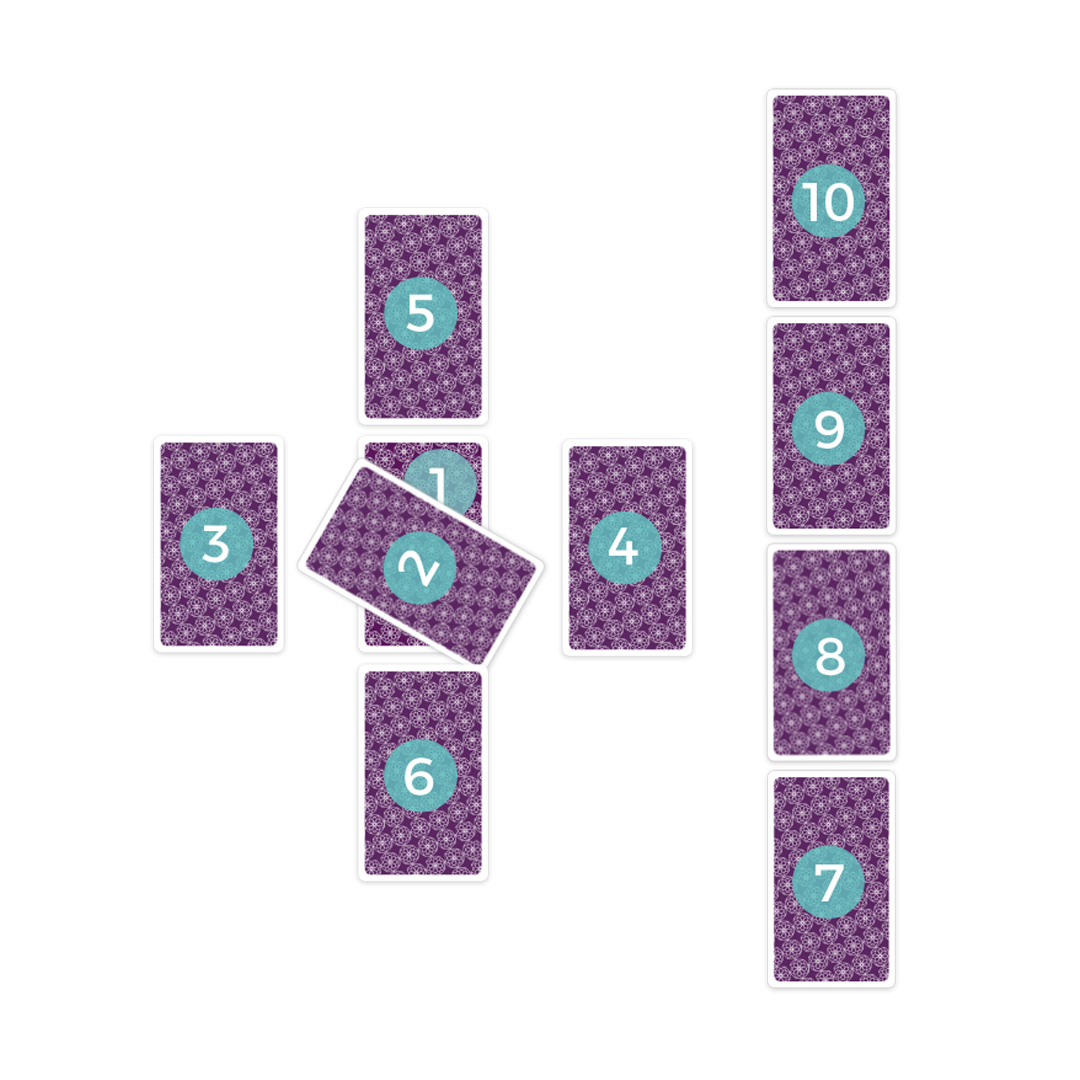
Card 1: The present
This card represents what is happening to the querent at the present time. It also reflects the querent’s state of mind and how they may be perceiving the situation.
Card 2: The challenge
This card represents the immediate challenge or problem facing the querent. This is the one thing that, if resolved, would make life a lot easier. Even if you draw a ‘positive’ card in this position, consider it carefully as it will still represent a challenge.
Card 3: The past
This card represents the events that have lead up to the present situation and may provide some indication of how the challenge came about.
Card 4: The future
This card represents what is likely to occur within the next few weeks or even months. This is not the final outcome, simply the next step on the journey.
Card 5: Above
This card reflects the querent’s goal, aspiration or best outcome with regards to the situation. It is what the querent is working towards consciously as they attempt to resolve the issue.
Card 6: Below
This card reflects that which is within the subconscious realm of the querent and delves much deeper into the core foundation of the situation. It symbolises the underlying feelings and trends associated with the situation and can indicate what is truly driving the querent. This card may bring a surprise message to the querent, particularly if they are not deeply connected to their inner being (watch out for reversed cards here which are likely to indicate that this is an ‘unknown’ to the querent).
Card 7: Advice
The advice card takes into account all that is happening within the querent’s life and presents a recommendation for what approach can be taken to address the current challenges.
Card 8: External influences
This card highlights the people, energies or events which will affect the outcome of the question and are beyond the querent's control.
Card 9: Hopes and/or fears
This is perhaps one of the most difficult positions to interpret. Keep in mind that hopes and fears are closely intertwined, therefore that which we hope for may also be that which we fear, and so may fail to happen. Sometimes it is useful to draw a second card for clarification after the reading has been laid and to read the two together.
Card 10: Outcome
This card is representative of where the situation is headed and if/how the issue will be resolved. It assumes the outcome based on the querent continuing their current course of action. Of course, if the outcome card is not a desirable outcome, it is within the free will of the querent to make the necessary changes to their situation.
*Note: There are many different versions of the Celtic Cross, including differences in the order of the cards. The version above is the version that I work with and have the best results with. Nonetheless, experiment and choose what works best for you.

Mastering the Celtic Cross: Exploring the Dynamics Between the Tarot Cards
This is where things get interesting! Many Tarot readers first learn to read Tarot by interpreting each card. But it's when we look at the dynamics between the Tarot cards and get into the story of the Tarot reading that the magic happens!
First, let’s imagine the Celtic Cross split into two main sections – the Circle/Cross section on the left (Cards 1 to 6) and the Staff section on the right (Cards 7 to 10).
The Circle/Cross shows what is going on in the querent’s life at the time of the reading. This section is made up of two crosses – a central one (Cards 1 and 2) nested within a larger cross (Cards 3 to 6). The smaller cross represents the heart of the matter – what is most central to the querent at the time of the reading.
The larger cross consists of two lines that overlay the smaller cross. The horizontal line (Cards 1, 3 and 4) shows time moving from the past on the left into the future on the right. The vertical line (Cards 1, 5 and 6) is the querent’s consciousness moving from unconscious on the bottom to conscious mind on the top.
Together these six cards give a snapshot of the inner and outer environment at the time of a reading.
The Staff section shows the relationship between the querent and the environment in which they operate, and can provide a better indication of what is happening in the broader context.
Second, start to look at the following Tarot card combinations to build the ‘story’:
- Compare the Above and Below cards (Cards 5 and 6). Is there a synergy between the conscious and the subconscious levels? Is there alignment between what is driving the querent and what the querent aspires to? If there is alignment, great – it will be a lot easier to resolve the issue. If not, then assist the querent in understanding what is happening at the subconscious level and how this may be impacting their response to the issue.
- Compare the Above and Outcome cards (Cards 5 and 10). Again, is there alignment between what the querent wants to happen and what will happen? Is the querent helping or hindering the situation? If you find that Cards 5 and 10 are opposing, then the querent will need to think carefully about how to create the outcomes they want. Look to the Advice card (Card 7) for more guidance.
- Compare the Future and Outcomes cards (Cards 4 and 10). How are the events of the near future contributing or influencing the overall outcome? Will the querent need to manage these events in a particular way to create the right outcomes? Again, refer to the Advice card (Card 7) for more detail.
- Compare the Below and Hopes/Fears cards (Cards 6 and 9). If you are finding it difficult to interpret the Hopes/Fears, have a look at what is happening at the subconscious level within the querent (Card 6). Is there something in their subconscious realm that is creating fear or hope? If you see reversed cards in these positions, then it is likely the querent is not yet aware of their subconscious drivers and how this is impacting them in the ‘real world’.
- Compare the Advice and Outcome cards (Cards 7 and 10). The querent doesn’t like the outcome? Well, take a look at the Advice card to see what actions the querent can take to create a more positive outcome. Also take into consideration what events are likely to occur in the near future (Card 4) so that the querent can manage these effectively.
Then, bring it all together for deep and profound insight into the situation at hand.
Ready to discover even more tips & tools for reading the Celtic Cross like a pro? Check out my Masterclass: Mastering The Celtic Cross With Ease!


 Harness the wisdom of the Major Arcana with 22 guided meditations. Here’s what you’ll get:
 Create a deeply intuitive and personal connection to the Tarot cards with your very own Tarot Card Meanings Workbook. Here’s what you’ll find inside the workbook:
 Here’s what you’ll find inside for every card in the deck:
 Start doing deep, accurate readings TODAY with this step-by-step accelerated program for beginners.